Tending to the soft garden within…

There is so much happening in this world right now that feels challenging to many of us. So much seems outside our control – and so much of what we believe in – equal rights for all, respect for each other, freedom to be ourselves – seems to be on the line. So how do we practice mindfulness at a time like this?

I can’t help thinking of words from Rumi:

Outside, the freezing desert night,
This other night inside grows warm, kindling.
Let the landscape be covered with thorny crust.
We have a soft garden in here.

Along with the challenges. there is also so much beauty around us. For along with the ten thousand sorrows, we can also open to the ten thousand joys in life…We can choose where we place our attention. And as the saying goes, where the attention goes, energy flows. We can choose to linger in those moments where ease, beauty, wellness and contentment is available. The moments when we are lifted up by the kind words or smile of another or the warm embrace of a friend. The moments when generosity abounds and human spirit prevails. Moments when we are touched by awe and wonder – a sunset, the cracked ice on the pavement, the cloud formations, the sound of a bird call. And, we can choose to be kind.

Kindness is the language that we all need most right now. Individually and collectively – choosing to be kind to self and others, practicing forgiveness and letting go, remembering to pause and step back from the cycle of reactivity is what can help us bring authenticity, wisdom, compassion and love into this world. And we can begin with looking within ourselves. What are we holding on to? What can we let go of?

In Attadanda sutta (Sn 4.15, translated from the Pali by Andrew Olendzki), the Buddha says:

Seeing people locked in conflict,

I became completely distraught.

But then I discerned here a thorn

— Hard to see — lodged deep in the heart.

It’s only when pierced by this thorn

That one runs in all directions.

So if that thorn is taken out —

one does not run, and settles down.

So, what thorns can be discerned and released? What can be healed and nourished? And can we move in this world with kindness? May this inquiry serve us all and help us move towards freedom.

With love, Shuba

Coming home: a practice for the new year…

Photo by Sindre Fs on Pexels.com

In the buddhist circles, often at the beginning of a retreat or meditation, a new year or new cycle, we chant the three refuges. With the three refuges, we take refuge in the Buddha, the Dhamma and the Sangha. Taking refuge in the Buddha is about coming home to the the awakened one within ourselves. Refuge in the Dhamma is about coming home to the deepest truths of the way things are. And refuge in the Sangha is about coming home to the community that sustains us, nourishes us and supports us in moving towards freedom. Most days, in my evening prayer, after lighting the candle, I use the three refuges to help ground me and remind me of why I practice and what is important and how to show up for my life.

I’m struck by this practice of coming home, especially at the turn of this new year. This practice of coming home is essentially what mindfulness is: coming home over and over again to the here and the now. For, this present moment is where the possibility of freedom is, the transformative power of love is. In a new translation of Rumi given to me by a dear friend, the first verse in the first poem in the book (Gold, translated by Haleh Liza Gafori), says:

“Let Love

the water of life,

flow through our veins”

-Rumi

In coming home, we return to this source, this love, this awareness which includes everything. The difficult and sublime thoughts, the aches and pains, the heartbreak, irritations, anger, sadness, grief as well as the joy, peace, ease, delight and enjoyment. And everything in between. This space has tremendous tenderness, aliveness, wisdom, intuition and grace. When we start to sense into this mystery – that nothing is separate from this flow of life, of love, of light, there is only one way to live: with compassion and kindness. To appreciate the gifts of each day. To allow ourselves to drop our armoring and be touched by life, by beauty and by gratitude.

May this new year allow you to come home and find many moments of peace and joy!

With love, S.

Cultivating restraint as a doorway to abundance…

Photo by Tabitha Mort on Pexels.com

I love the month of December! It is a month that evokes the sentiments of celebrating snow, the people in our lives and the merriment of the holiday season. I also often find myself overwhelmed in the month of December. Any budget I set during this month quickly goes out the window and watching holiday movies and indulging in treats often leave me depleted. The word that best describes this month for me is excess. And what better time to practice restraint!? The best way we can learn the timely cultivation of balance and restraint is when we come directly face to face with overwhelm. So where and how do we start?

We start right here. where we are. By grounding in the body. Feeling the sensations of feet touching the ground. Pausing the activity. Softening and relaxing. And by reconnecting with our intention. We remember what is important. we remember the gifts that are already present in our lives. We appreciate the relationships that nourish us. We take the time to do a gratitude inventory each day as the botanist and writer Robin Wall Kimmerer reminds us. And we rejoice in the present moment and all that it has to offer – including the anxiety and overwhelm. Nothing needs to be pushed away – everything can be welcome and seen and let go of. And in this way, we move closer to freedom. I leave you with one of my favorites:

Humble living does not diminish.  It fills.
Going back to a simpler self gives wisdom.

When a man makes up a story for his child,
he becomes a father and a child
together, listening.

~Rumi

With love, S.

Reflecting on Lineage in Meditation Practice…

Photo by Irina Iriser on Pexels.com

Recently, an aspect of practice that has been helpful to me has been reflecting on lineage. This has been true both in my personal practice as well as professional life. As an educator, I’ve been very aware that I’m following in the footsteps of countless wise educators before me. Similarly, in my meditation practice, I’ve been very aware of the fact that I’m following in the footsteps of those who have walked this path for thousands of years before me.

In a recent group with dharma friends, we were reading one of the middle length suttas (MN 100) in which we came across the story of Dhananjani, who tripped and expressed spontaneously homage to the Buddha, the awakened one. I have chanted this traditional homage so many times – and this was once chanted by Dhananjani too – in a different place at a different time! In that moment, I felt this incredible connection with Dhananjani – one that transcended space and time.

When we reflect on our lineage, on those who have supported us, and have walked the path before us, and with us, we feel ourselves belonging to something larger than a small self. A spaciousness opens up, this tremendous felt sense that we are not alone. A touch of awe for all the causes and conditions that have brought these practices to us. And a commitment to practice not just for our benefit but the benefit of others as well.

And this awareness can support us in those difficult moments when wisdom feels elusive: maybe it is elusive to the small self but not to this large spacious awareness that has the voices of all the practitioners before us. The love, the wisdom, the compassion increasingly becomes available to us because we too belong. We belong right here, in this moment, with all our struggles, hopes and despairs, joys and triumphs, pain and loss. And we are not alone. We can surrender more easily our agendas and stories into this vast loving presence that is empty of self. Rumi says this eloquently:

I saw you and became that empty.
This emptiness, more beautiful than existence,
it obliterates existence, and yet when it comes,
existence thrives and creates more existence.

So we can turn our attention towards this existence that has humility, gratitude and tenderness. Turning our attention towards what nourishes us and sustains us is wise effort – and we know that where we place our attention matters. It does not mean we deny what is difficult or challenging. But there is just a bit more space – for ease, belonging and connection with the present moment.

So the journey goes on,
and no one knows where.

Just to be held by the ocean
is the best luck we could have.
It is a total waking up.

Why should we grieve that we have been sleeping?
It does not matter how long we have been unconscious.

We are groggy, but let the guilt go.
Feel the motions of tenderness around you.

-Rumi

May you feel the motions of tenderness around you and may many blessings continue to unfold in your life!

With love, Shuba.

ps: And if you are interested in practicing with me, consider joining me for the upcoming mindfulness session this Saturday. You can find details here.

Living itself as a friend…

Meditation is old and honorable, so why should I not sit, every morning of my life, on the hillside, looking into the shining world? Because, properly attended to, delight, as well as havoc, is suggestion. Can one be passionate about the just, the ideal, the sublime, and the holy, and yet commit to no labor in its cause?’ -Mary Oliver

I love these words by Mary Oliver and I believe them whole heartedly! At its core, walking a spiritual path requires discipline, it requires commitment and labor, it requires showing up when things are good and showing up when things are not so good. It requires sitting on the cushion when we feel alert and balanced and full of vigor and also when we feel tired and sleepy and not so full of vigor! Above all, it requires letting go of purpose and agenda…and trusting that wherever we are is exactly where we need to be.

‘Be courageous and discipline yourself…Work. Keep digging your well. Don’t think about getting off from work. Water is there somewhere.’, says Rumi. All these wise words point to showing up and doing the work.

And yet, how do we respond when we forget to show up? That too is part of the practice! Do we berate ourselves and pile on the self judgement or do we soften in tenderness for the challenging life circumstances that have prevented us from coming to our mat, or cushion? Above all, do we give ourselves permission to begin over?

Beginning over and over is the practice. And we do it not because its what we should do, but because we have a choice and it’s what we choose to do. And every time we choose to begin over, we open the door to spontaneous joy, the joy that arises from making time to listen to our soul, our spirit, the inner most voice inside that speaks only when we become silent… And that spontaneous joy that ‘comes and sits softly on my shoulder’ (in the words of Thoreau) gives me the courage to stay on the path.

So, here is to discipline and joy and supporting each other on the path…

With metta, S

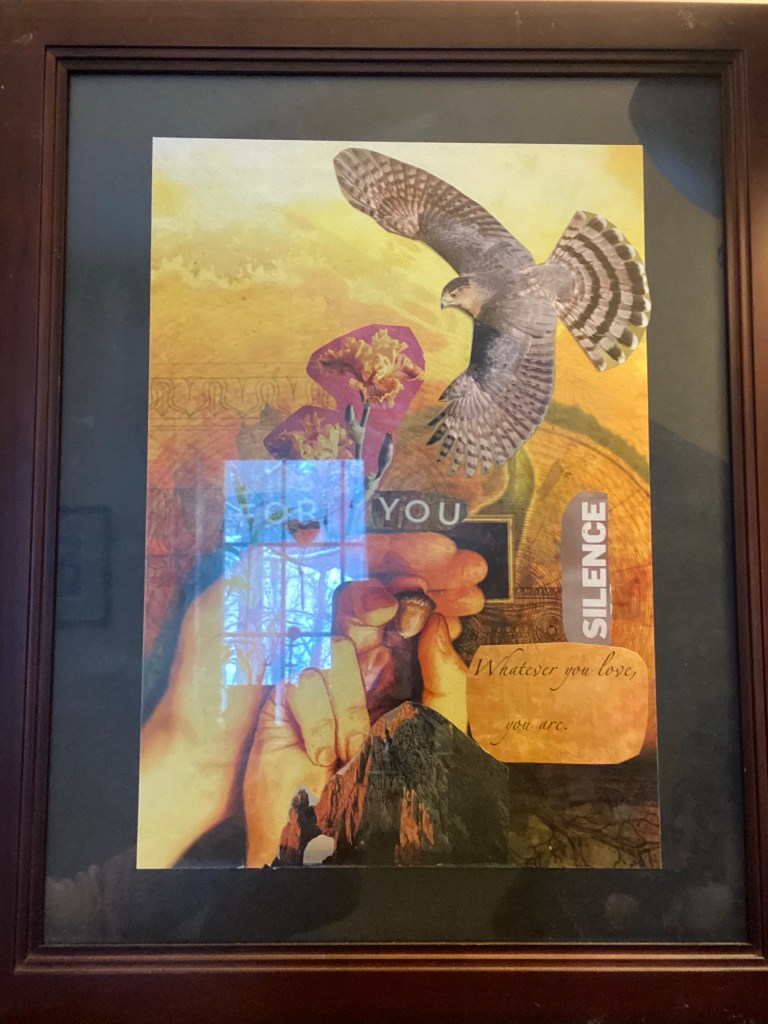
Ps: please enjoy my latest collage for which I used Brush Dance’s Rumi calendar from 2007 as backdrop…

In taking the photograph, the reflection of the window adds an interesting dimension! The words at the bottom are from Rumi as well.

Creative living…

One of my absolute favorite poems of Rumi is this one…translated by Coleman Barks:

Today, like every other day, we wake up empty
and frightened. Don’t open the door to the study
and begin reading. Take down a musical instrument.
Let the beauty we love be what we do.
There are hundreds of ways to kneel and kiss the ground.

Everyday life presents us opportunities to do what we love, in little and big ways, whether it is because we are frightened or because we are joyful! This has never been more true perhaps than now, for us who are living through this pandemic. We have experienced contraction and expansion in a variety of ways and most of all we have all experienced transformation…

For me, these past few months have opened up a well of creative living… whether it is in trying new recipes or foods, or in crafting collages and knitting projects and designing jewelry or in simply playing with time in spontaneous ways…Professionally, I am a high school math teacher so being in the classroom everyday presents its own challenges and rewards, but most of all, it reminds me to take care of myself, model that for my daughter and make time for play!

As I was talking to a friend about my new projects , she suggested starting a creativity journal! I don’t want to use yet another blog space but thought I would experiment using this space for some of my work…it will certainly help me be more regular in blogging!

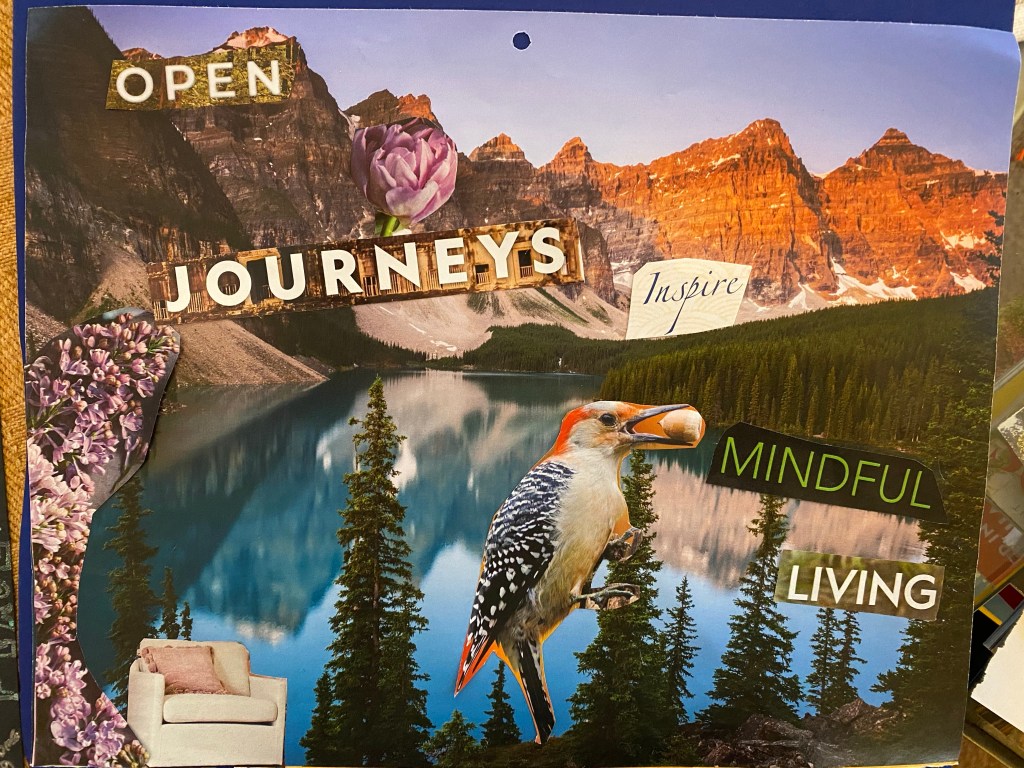
So hope you enjoy what is to come…. this collage below is inspired by my intentions for my upcoming teacher training program and was done on this snow day today, with my amazing incredibly talented ten year old daughter who made her own collage (not shown here) and will probably start her own blog when she is old enough! 🙂

The woodpecker, according to Ted Andrews, author of Animal Speak, represents new rhythms, and we sighted a couple of woodpeckers in our yard on New Year’s Day! It also represents discrimination, in what we take on in life so that we protect our time and our practice! And I really wanted to find a seat to represent meditation. Finally, the background is from the Nature Conservancy 2020 calendar!

With metta, S

Abiding in loving-kindness…

Abiding in loving-kindness or metta has this slow flowering quality of opening our hearts. It doesn’t ask for us to be perfect, but simply that we are willing to aspire and practice to be unconditionally loved and loving.

As many of you know, I am drawn deeply by the ecstasy, joy, truth, contradiction and union in Rumi’s poetry. I love reading Coleman Barks’ introduction in his many books of Rumi poetry, about the story of how Rumi and Shams met and how their friendship began, outside of time. When Shams disappeared, Rumi journeyed and looked for him everywhere, until one moment, one day, he realized that Shams was within him. And out of that union came so many of his songs and poems celebrated throughout the world. As Rumi says, “when living itself becomes the Friend, lovers disappear.”

When I attended my first metta retreat with Michele Mcdonald back in 2008, it was my first taste of this unconditional love and friendship. In metta, we concentrate on phrases/wishes of well-being for our benefactor; not with the aim of controlling their happiness or well-being, but to gently ease into and abide into our own heart’s capacity to love and wish others well, independent of their accomplishments or qualities. We start with the benefactor, because this is our ‘easy’ person, the person for whom wishing well comes easily to us. As we practice, our hearts expand in friendship and good will and then it becomes easier to extend those wishes to ourselves, neutral and more difficult people, in that order. Ultimately, our aspiration is to wish all beings on earth this same unconditional good will and friendship, as we would wish for our dearest ones.

Being a parent offers a beautiful doorway to practice this metta journey. When I sit in meditation and begin with metta for my daughter, Anjali, it is easy to wish her well. Her sweet face fills my consciousness and brings me immense joy. Not because of her accomplishments or certain qualities she possesses, but simply because of who she is. A radiant being of light and joy, for whom my wishes of friendship, health, safety and love flow easily and naturally. When I abide in the love I feel for her, and slowly turn it like a mirror towards myself, this magical alchemy occurs. I too am worthy of the same love that I extend to my child. Sometimes I find myself wondering who is the mother and who is the child.

Moon and clouds are the same. Mountain and valley are different. All are blessed; all are blessed. Is this one? Is this two?” – Wu-Men.

This abiding in unconditional love and friendship is the state from which we can then act in the world. Can we extend that same unconditional love to difficult people in our lives? This is certainly more challenging but as we keep coming back to the practice, our heart slowly opens and learns to relate in a new way to others. Extending this good will does not mean we condone others’ unskillful actions. But it allows us to respond from a place of wisdom and grace, simply because we acknowledge that we are all human, imperfect and worthy of love, friendship and respect.

I cannot say that I can love all human beings the way I love my daughter. If I did, I would be an enlightened being. Instead, I am very much imperfect, impatient with myself, insecure at times, trying too hard, demanding at times. But in loving her, I am discovering a far greater capacity for love and healing than I ever thought possible. Always remembering patience and diligence. And that, as Daniel Mead puts it beautifully in his poem, “A flower cannot be opened with a hammer.

May all beings abide in this friendship and metta,

With love, S.

ps: Please note that all Rumi references in this post are translations by Coleman Barks. If you would like a recommendation of his poetry, my favorite is his book ‘The Glance’.

Full Moon, Fish and Bird…

For a while in my life, Rumi poetry was part of the fiber of my being. I read a lot of his poems, and some of my close friends know that I have made some significant life decisions inspired by Rumi. Then, for a while, I took a Rumi break. I think I needed it, to be able to let go of my experiences of the poems and see them anew. That is one of the reasons I am so happy and excited to be back in Rumi-sphere again. So much thanks to Coleman Barks and to Mary Oliver (who read Rumi until her last days…a beautiful essay of her life here).

Today’s poem, from a year with Rumi, so apt for this full Moon, has this beautiful passage:

I am a fish. You are the moon.

You cannot touch me, but your light

fills the ocean where I live.

Rumi (translated by Coleman Barks)

I was inspired to write a verse in response to Rumi.

I am a fish. You are the moon.

Every one of your moon beams

has transformed me from within

so that I am a fish no more.

Instead I am a bird flying high

in the wide open sky

to be closer to you.

Shuba (with a bow to Rumi)
Photo by Frank Cone on Pexels.com

I am leaving you with this. I didn’t think Rumi would mind. What do you think?

Namaste, S.

Deep Purple Delight, a verse and more…

Last night, inspired by my teacher’s challenge, I was moved to write this short poem about Anjali:

Deep Purple Delight

In her purple-rimmed glasses,

and her deep lilac pullover,

She looks at me, her face shining pink:

Abounding in laughter,

bursting with delight,

Her whole being is alight with joy!

In that moment,

my breath catches, and my heart softens,

as I gaze in marvel at this radiant being of light!

Photo by SplitShire on Pexels.com

Imagine my surprise as I turned to today’s poem in my copy of ‘A Year with Rumi’ and saw the poem titled: ‘Who says words with my mouth’. It made me laugh. Here are a couple of lines from the end of the poem.

This poetry. I never know what I’m going to say.

I don’t plan it. When I’m outside the saying of it,

I get very quiet and rarely speak at all.

Rumi (translated by Coleman Barks)

How apropos! I had written the poem after my nightly-ish meditation.

So, there it is: this quiet that is always there within us, waiting. Before or after the words. Just waiting for us to sit and wait in return. That is the marvel of the practice of returning home. Watching the breath, listening to the sounds, witnessing the thoughts, cultivating the love. Do you feel it? This beckoning of the silence from which the words spring? We just show up over and over again.

So, I return to my deep purple delight. May yours be filled with light!

Namaste, S.

That is the marvel of the practice of returning home. Watching the breath, listening to the sounds, witnessing the thoughts, cultivating the love.

Balance…

I was reading a magazine today and came across the bio of the author: ‘she balances being senior editor with yoga and teaching’, or something of the kind. I have read so many such bios, and written such bios of myself. Somehow today it made me pause: the word, ‘Balance’. We are always balancing. We are juggling so many things in life, and learning to balance on the ice, without letting it all drop. We lose our balance a lot – and that’s partly how we learn which direction we have to lean again – to regain our balance.

This month has been a lot about this lesson of balance for me. After a packed few months of so many events – birthdays, Diwali, Halloween, and work and doing too many things, my body took a pause. I had a really bad cold and it lasted for about 10 days. It forced me to get a lot of rest, less of talking, less of doing, and more of surrender. It was a reminder that we can’t always do things simply by force of will. The heart needs to follow. And as the beautiful poem by Daniel Mead, pasted on the door of my room reminds me, ‘a flower cannot be opened by a hammer’.

I had taken up swim lessons and confronting my deep fears from nearly drowning once. Watching Anji had inspired me and I was determined to ‘do it!’ this time. My body did not feel the same way. I have managed to attend classes once a week instead of two – and have had a lot of pain in left arm from possibly over-rotating. And then I couldn’t go, because I got sick. Maybe group lessons are not for me. I have also realized that maybe no push is needed.. Maybe the only deadline is my own. Maybe it will all happen in good time. Maybe I don’t need to ‘swim’ by tomorrow!

I had also resolved in the beginning of November, to commit to a more regular yoga practice. This has also been really powerful. It has also brought many questions into my attention. What modifications can I offer myself when I am sick? Can I be kind? Can I redefine success? I have not been on my yoga mat everyday, but my resolution has been successful nevertheless. I have come to yoga more often, and that has been super. I also found that since I had committed to only 5 poses, that was simple to practice and I didn’t always need to dedicate 45 minutes to an hour to practice. Sometimes 20 minutes was plenty. I also found that I had to bring mindfulness to how much I wanted to do each day, where my body was, and which poses. It has been a creative exercise as well as one of bringing attention. I have done poses I haven’t in a long time. I have also just showed up and done legs up the wall pose. My body leading the way has made me happier. And realizing that there is nobody else judging this but myself has been liberating, as always. I can be softer, kinder and when I do, I miraculously bring this into my life.

As Rumi says, ‘let the beauty we love be what we do. There are hundreds of ways to kneel and kiss the ground’. May all our paths lead to more ways of discovering this…

Peace to you and happy thanksgiving!

Shuba